

09.12.2025 / 18:00h
In the early 1960s, elementary education was made compulsory in Kosovo for boys and girls alike. Yet this de jure change did not reflect a meaningful change in the lived realities of most school-aged girls from Kosovo Albanian households. The intersection of patriarchy, poverty and the regime’s increasing anti-Albanian oppression cut short their education.
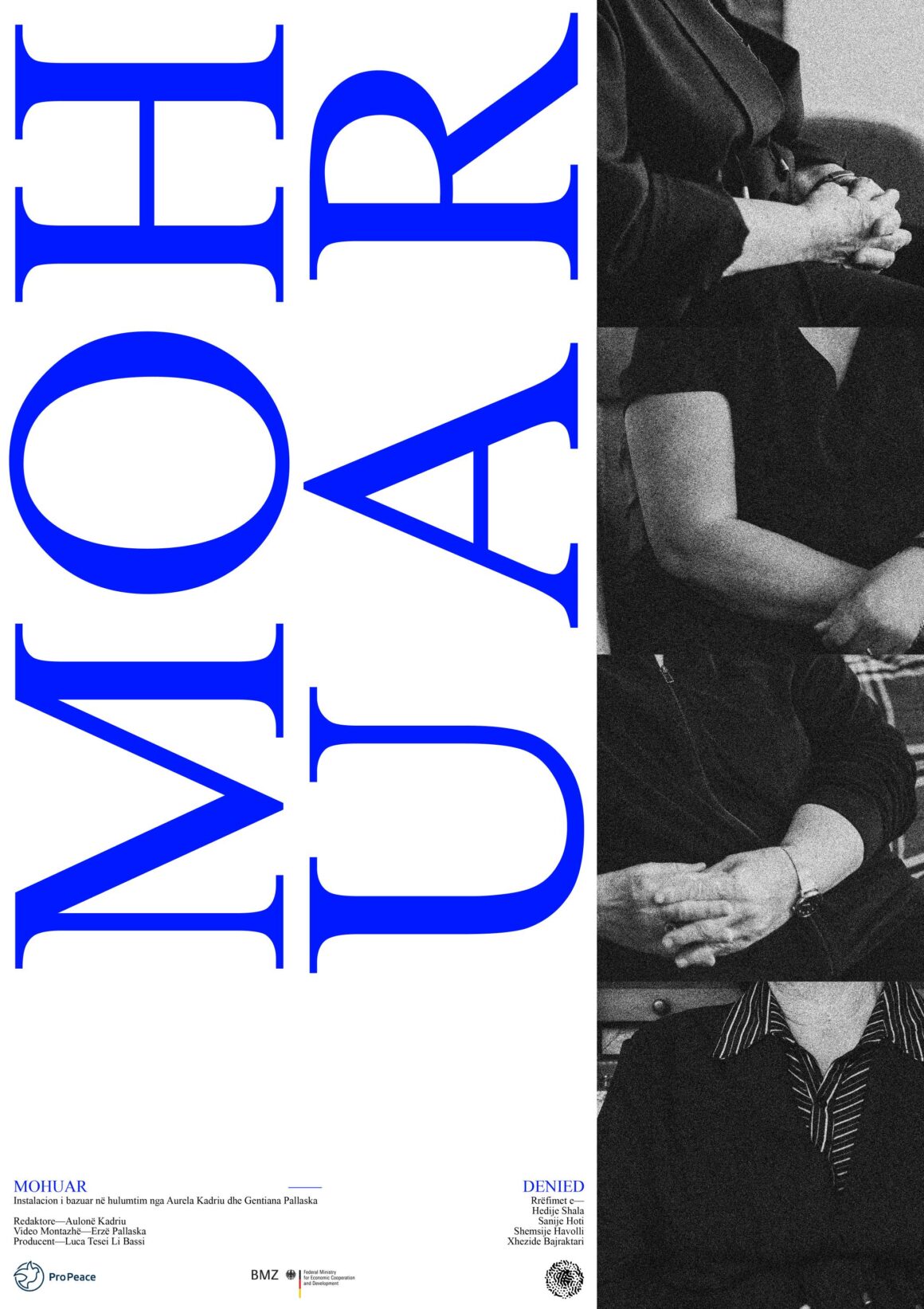
This denial had to remain hidden, and with it, memory of the injustice faded from public discourse. Through first-hand video-testimonials, MOHUAR [Denied] brings forth the stories of four women from across Kosovo who were denied education between 1960 and 1980. Hedije Shala, Sanije Hoti, Shemsije Havolli and Xhezide Bajraktari share their personal recollections and the meaning they have drawn from decisions — made for them, not with them — that profoundly affected their life trajectories.
MOHUAR builds on a multimedia research project. Through photography, spoken and written narrative, it adds a physical dimension to the multimedia (text and photography) story co-authored by Aurela Kadriu and Gentiana Pallaska — an onsite, embodied iteration that allows us to meet, visually and physically, the women who lived it.
MOHUAR is a work in progress of the authors and this part of the research is supported by Pro Peace, an organization dedicated to diversifying conversations on memory and the past across the Western Balkans.
A research based installation by Aurela Kadriu and Gentiana Pallaska
Stories of—
Hedije Shala
Sanije Hoti
Shemsije Havolli
Xhezide Bajraktari
Editor—Aulonë Kadriu
Video Editor—Erzë Pallaska
Producer—Luca Tesei Li Bassi
—
This exhibition is supported by Pro Peace – Kosovo